
Pullman Previous Resident Sources
No single roll spans the life of a Pullman address. Current ownership appears in the county parcel system. Recorded transfers lead back through deeds, while printed directories, telephone books, census schedules, newspapers, and maps fill years between sales. The strongest previous residents result states exactly what each source proves. Ownership is not occupancy, a telephone listing can omit a household, and a newspaper address can describe only one event.
| Source | Years It Covers | Where Held | What It Shows |
|---|---|---|---|
| Whitman EagleWeb | 1980 to present online | Whitman County Auditor | Grantors, grantees, dates, file numbers, legal descriptions, and available images |
| Pullman city directories | 1891, selected 1904 to 1985 editions | State Library and archive referrals | Names, addresses, and occupations in an edition year |
| Pullman telephone books | Selected 1937 to 1977 editions | University of Idaho Special Collections | Subscribers, telephone numbers, and listed addresses |
| Federal census | 1850 to 1880 and 1900 to 1940 in cited library access | NARA, State Library, and FamilySearch | Household members and location on the enumeration date |
| Local newspapers | Tribune 1895 to 1919; Herald through 1922 | WSU digital collections and microfilm | Notices, obituaries, businesses, and dated address clues |
| Sanborn map | March 1896 | Library of Congress | Seven sheets of building, street, and land-use context |
Start with TaxSifter for a modern parcel, EagleWeb for a transfer recorded since 1980, or the nearest printed directory for an older household. If the question reaches past the web index, the Auditor counter in Colfax, Washington State Archives, WSU Libraries, Neill Public Library, and Whitman County Historical Society form the fallback chain. These routes matter because Pullman's surviving directory run has large gaps.
Fix the Pullman Parcel First
Open Whitman County TaxSifter and save the parcel number, situs address, owner name, mailing address, and legal description. The situs is the mapped location. The mailing address is where tax notices go and may be a post office box or a place outside Pullman. Neither field alone establishes who sleeps at the address.
The parcel number and legal description are the durable links. They can survive a shift in street spelling, a new unit label, or a lot split. Pullman GIS also supplies lot, block, subdivision, ZIP, municipality, and public land context. County data is a reference tool, not a legal survey. When two records disagree, keep both versions and let the recorded instrument control the ownership question.
For the present-day by-address method, the Pullman street directory explains the full parcel and street workflow.
Walk Whitman Deeds Backward
The Whitman County EagleWeb index is the core path for past owners. Its public index and images begin January 1, 1980. Search is free. An ordinary high-quality image or print is listed at $1 per page, while plats, surveys, certified copies, and older books require help from the Auditor.
- Copy the current owner and legal description from TaxSifter. Keep the situs and mailing address in different fields.
- Search the owner as a grantee, the person receiving property. Narrow by date, document type, municipality, block, or lot.
- Open the purchase record. Save the grantor, grantee, recording date, auditor file number, and legal description.
- Search that grantor as an earlier grantee. Repeat the same checks, and use Related Searches for instruments tied to the legal description.
- At the 1980 online boundary, contact the Auditor for older deed books, plats, surveys, and certified copies.
- Grantor and grantee
- The grantor gives or sells an interest; the grantee receives it.
- Chain of title
- The ordered series of recorded transfers affecting the same property.
- Legal description
- The formal lot, block, subdivision, or land description used to identify property apart from its street address.
The EagleWeb help screen explains surname-first basic searching, wildcards, required and excluded terms, municipality plus block and lot fields, and lot ranges. Those tools can separate same-name parties and reconnect a renamed address to the right parcel.
View the official EagleWeb deed index before following a Pullman chain.
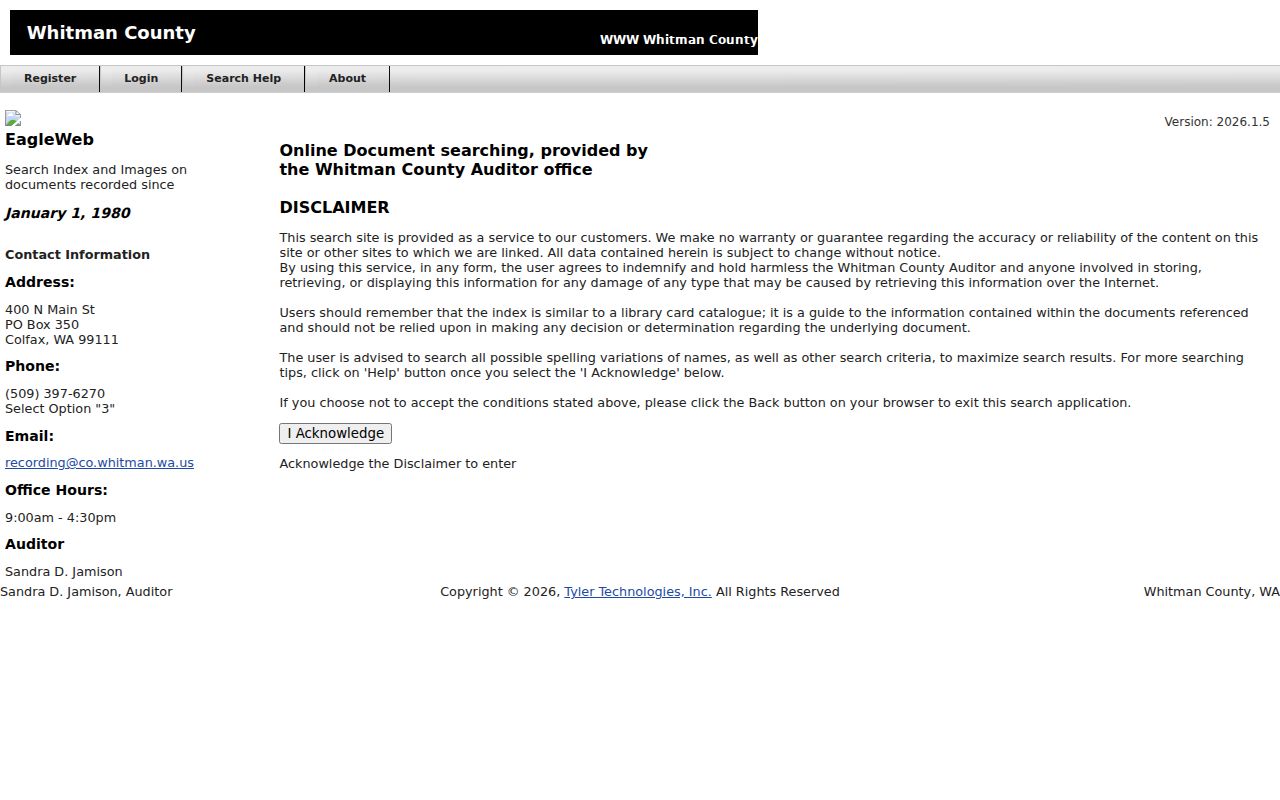
The screen confirms the official starting point, but the indexed names and image link still need to be tied to the same legal description.
Pullman Records Before 1980
EagleWeb's cutoff does not mean earlier deeds are gone. The Whitman County Auditor's Recording and Marriage Licensing office is at 400 N Main Street, Suite 245, in Colfax. Published hours are Monday through Friday, 9 a.m. to noon and 1 to 4:15 p.m.; recording service ends at 3:30 p.m. Call 509-397-6270 or email recording@co.whitman.wa.us before a trip.
Give staff the current legal description, known instrument number, parties, and a narrow date range. Ask which older index book, deed volume, plat, or archive series should be checked. The exact pre-1980 online book sequence was not confirmed in the research, so a specific volume should not be guessed. Washington State Archives and WCHS can help when the county record has moved or needs context.
Note: Confirm office hours and fees before ordering, since older volumes and certified products follow different handling rules.
Match Pullman Directories to Census
Deeds show owners, not each person in a home. To identify previous residents, select the nearest Pullman directory year, transcribe the entry exactly, and compare it with the closest census schedule. Washington State Library lists selected Pullman directories in 1904, 1908–09, 1915–16, and scattered years from 1957 through 1985. Telephone books fill selected dates from 1937 through 1977, but they list subscribers rather than all residents.
- Choose the directory edition nearest the event or deed date. Save the title, year, page, spelling, and address.
- Check the edition before or after it. A move, death, business change, or simple gap may explain a missing name.
- Pair the result with the closest released census year. Note that a census is a dated count, not an annual roll.
- Use a newspaper, vital index, obituary, or probate file to explain a surname change or the end of a household trail.
- Compare the address with the legal parcel and map. Leave any uncertain street-number match unresolved.
The full shelf history belongs on the Pullman city directory page. For this backward-address task, the aim is to place a named household at the address in a stated year, not to assume continuity between editions.
Pullman Business Address Trail
Whitman County Historical Society documents Esther Pond Smith's Pullman Business Directory: 1881–1993. The handwritten index is organized by business name, with marks for operating years, address changes, and some proprietor clues. For a shop, office, hotel, or other commercial parcel, that makes the index a reverse directory in practice.
Search the business name first, record each year and place change, then compare the proprietor with deeds and newspaper notices. The source is a finding aid rather than a complete resident roll. It can still bridge years missing from the printed city directories and show when an old street address referred to a business rather than a home.
Review WCHS resources and research service details for a Pullman address.
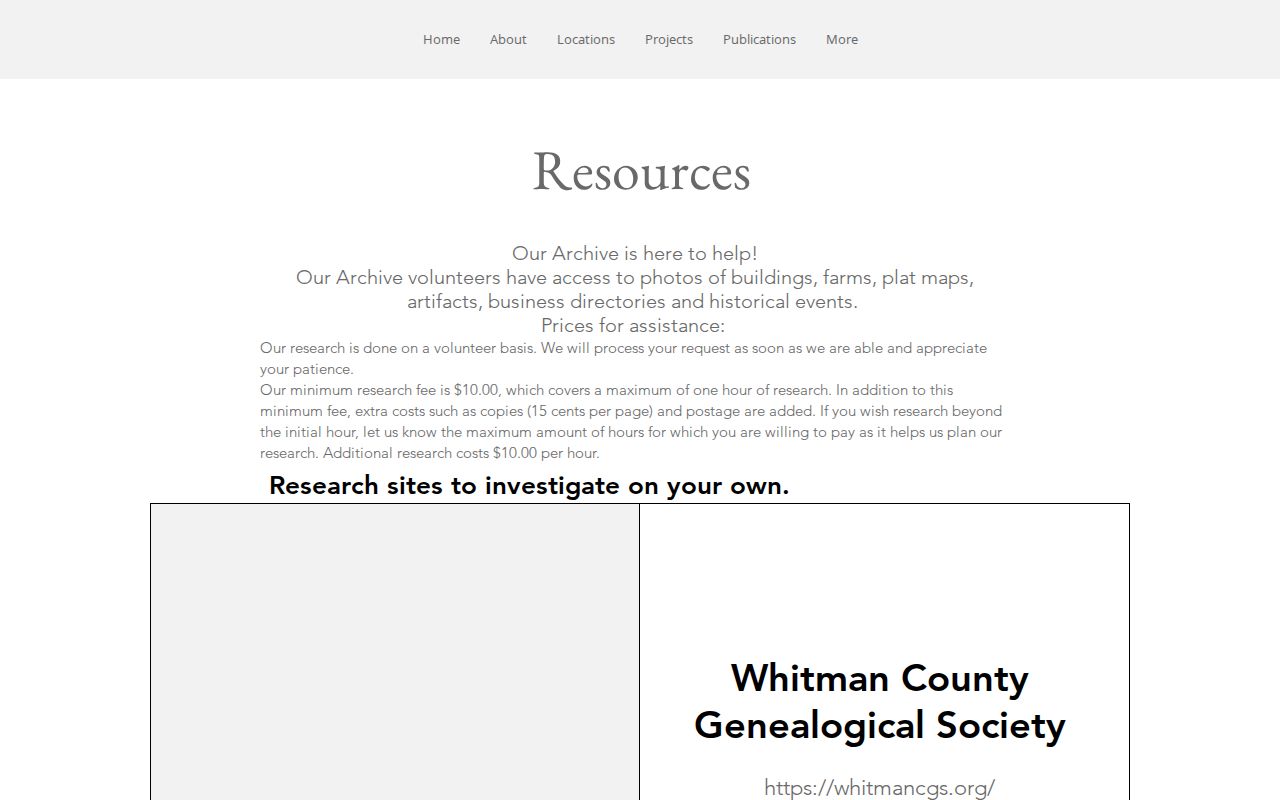
The society's indexes, plats, photos, and local publications can fill a gap, but its listed archive addresses conflict, so verify the visit location by email.
Date a Pullman Building
The March 1896 Pullman Sanborn map has seven sheets. It can show a building footprint, street, and use at that date. It does not identify the people inside. Compare a mapped structure with a directory entry and deed rather than turning the map into an occupant list.
For newer changes, Pullman's EnerGov permit portal may help, but the exact public fields and historical start were not confirmed. Ask the City Clerk or Community Development for address-specific permit or code records. A useful request gives the street address, parcel number, record type, date range, and desired delivery format. In-person City Clerk inspection is available at Pullman City Hall, 190 SE Crestview Street, during published weekday hours. Mail, phone, and a written Washington Public Records Act request are the fallbacks when the portal does not return the needed record.
Test Pullman Address Continuity
No complete official Pullman street-renumbering or renaming bridge was found. Do not silently convert an old number to a modern one. Instead, compare subdivision, lot, block, parcel, nearby named features, and the dated map. Pullman GIS exposes postal ZIP, municipality, parcel ID, lot and block, plus city and county fields on each side of a road.
The old 99165 College Station ZIP can also appear in records. USPS discontinued it in 2006 and directed mail to Pullman 99163. That postal change can explain a mismatch, but it does not prove that a street or building changed. For WSU business mail, 99164 is an institutional routing clue rather than a normal residential area. Keep the full address as printed in each source.
Close Pullman Household Trails
The WSU Pullman Tribune collection contains 525 issues from 1895 to 1919 and is mostly complete from 1910 through 1919. WSU also describes the Pullman Herald as digitized through 1922. Search a surname with the street, business, spouse, or estate terms, then save the issue date and page. Missing issues can be checked on Holland Library microfilm or with WCHS originals.
Probate may connect a deceased owner with heirs and a later deed. Use Odyssey to locate a Whitman County matter, then request the actual file from the County Clerk. Protected details may be redacted. Pullman's cemetery GIS can also provide grave, lot, name, birth, death, interment, veteran, and transaction fields for corroboration. A burial record is an endpoint, not proof that the person lived at the searched address.
When no online index answers the question, use WSU MASC, Neill Public Library, WCHS, the State Library, State Archives, FamilySearch catalog access, county counters, and focused mail or email requests. Record a gap instead of supplying a name that only seems likely.
Use Pullman History Lawfully
A sound previous residents file separates owner, occupant, subscriber, court party, heir, and buried person. It dates each source and preserves the record number or page. That makes family history, estate research, and house history more useful while reducing the chance that two people with the same name are merged.
Washington's Address Confidentiality Program protects qualifying people through substitute addresses, and protected voter information is withheld. Utility-customer and DMV addresses are not public substitutes. Current names should be handled with care, even when an old deed or directory is open.
Lawful use. Research past Pullman residents for house history, family history, or a defined personal matter. Never use records to track, threaten, or harass anyone.